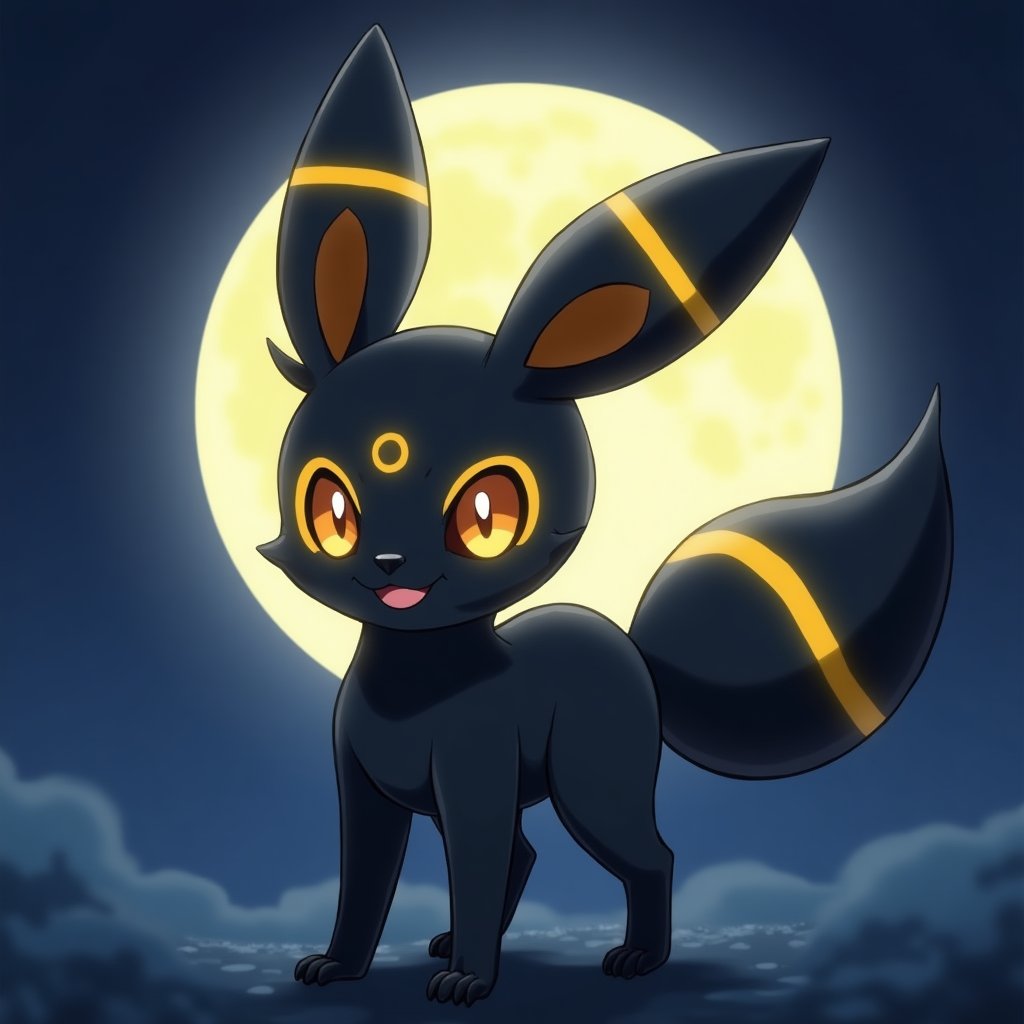
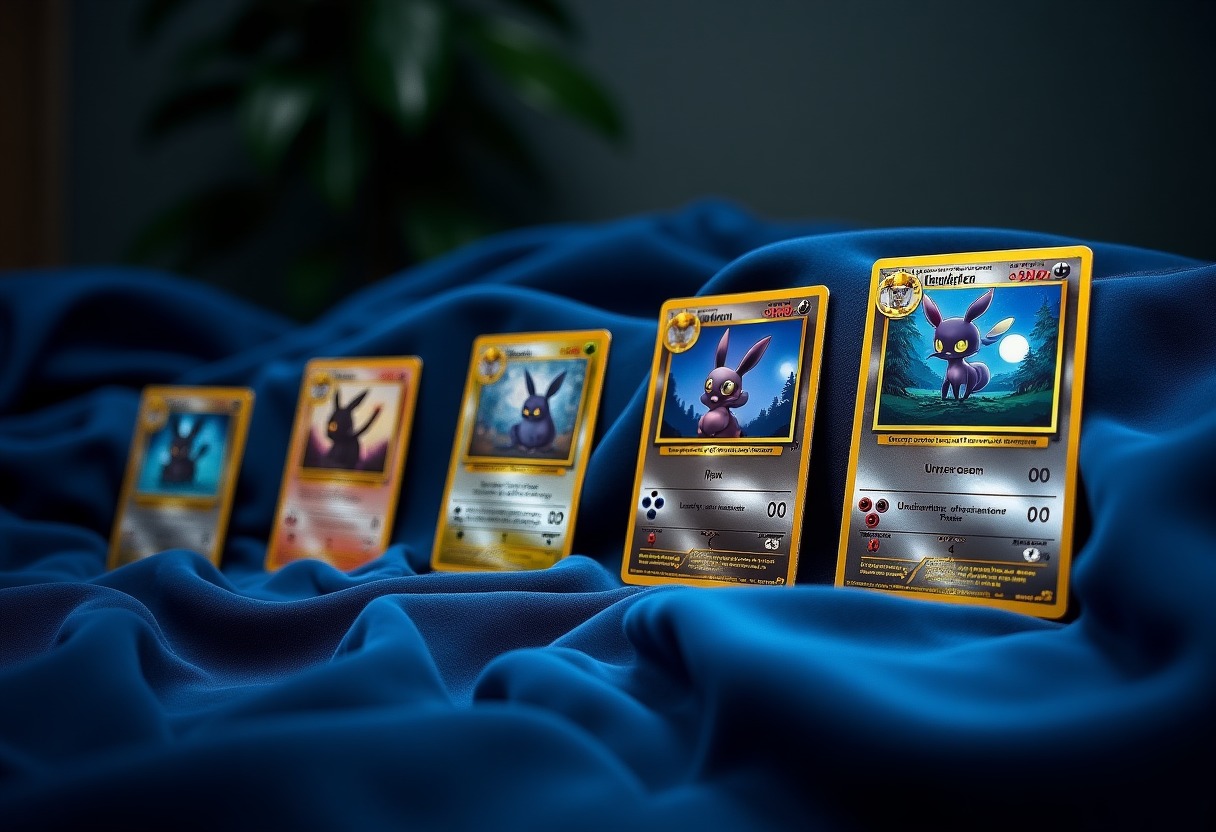
Umbreon's first Pokémon TCG appearance in Neo Discovery (2001) showed a crouching defensive pose against a yellow backdrop — Ken Sugimori's official art translated directly to cardboard. Twenty-three years later, the same Pokémon commands six-figure auction prices for alternate art VMAXs depicting moonlit scenes with Leafeon. The transformation from functional game piece to coveted art collectible mirrors the entire TCG's maturation, and Umbreon sits at the center of that evolution.
Why Umbreon's Art Journey Matters to Collectors
Umbreon entered the TCG as Generation II's Dark-type Eeveelution, immediately distinguished from its seven siblings by both typing and aesthetic. Early cards relied on Sugimori's definitive poses — the yellow-ringed patterns glowing against dark fur became Umbreon's visual signature. But as the TCG expanded beyond simple gameplay into a collectible art medium, illustrators gained permission to reimagine these Pokémon in new contexts.
The shift accelerated around the Black & White era (2011-2013) when The Pokémon Company began commissioning diverse artists beyond Sugimori's in-house team. Suddenly, 5ban Graphics rendered Umbreon in dynamic 3D CG. Kouki Saitou painted watercolor nightscapes. Mitsuhiro Arita — who'd been illustrating cards since Base Set — brought expressiveness to Umbreon's face that earlier cards lacked.
The real inflection point came with alternate arts in modern sets. These premium chase cards feature full illustrations that bleed past the traditional border, often depicting Pokémon in narrative scenes rather than isolated poses. Umbreon's Umbreon VMAX Alt Art from Eeveelution Heroes (2021) shows it alongside Leafeon in dappled forest light — a composition that commands $400-600 in near-mint condition according to Most Valuable Umbreon Cards Ever.
Early Era: Neo Discovery Through Diamond & Pearl (2001-2009)
Umbreon's Neo Discovery debut established the template. Ken Sugimori's clean linework emphasized recognizable silhouette — crucial when the TCG was still building brand recognition globally. The yellow rings popped against purple-black fur, readable even in small card format. No environmental context, just the Pokémon centered against a solid or gradient background.
Neo Destiny (2002) introduced the first Dark Umbreon, playing on the typing's sinister implications. The composition stayed conservative — three-quarter view, neutral expression — but the "Dark" prefix in the name nodded to the narrative possibilities that later artists would explore.
EX-series cards (2003-2007) maintained this approach. Umbreon ex from EX Unseen Forces showed slight advancement — a nighttime rooftop setting hinted at environment, though Umbreon itself remained centrally posed and forward-facing. The illustration by Ryo Ueda added atmospheric fog, but the Pokémon's positioning prioritized card readability during gameplay over artistic experimentation.
Diamond & Pearl era (2007-2009) marked subtle shifts. Majestic Dawn's Umbreon by Ken Sugimori Jr. (distinct from his father) depicted a slight crouch with more personality in the eyes. Undaunted's Umbreon Prime by Hideaki Hakozaki introduced the first truly moody lighting — shadows cast across the face created depth that earlier flat-lit cards lacked.
Modern Transformation: Black & White Through Sword & Shield (2011-2024)
Black & White sets liberated illustrators. Dark Explorers (2012) featured Umbreon by Masakazu Fukuda in three-quarter profile with backlighting that made the yellow rings luminescent rather than just colored. The background suggested a nighttime cityscape without overwhelming the subject — a balance that became the modern standard.
The real breakthrough came with full art cards. XY Fates Collide (2016) introduced Umbreon-EX full art by 5ban Graphics — photorealistic 3D rendering that showed every fur texture and ring pattern detail. Love it or hate it (and collectors remain divided), the CG approach proved Umbreon's design worked across all illustration styles.
Sun & Moon era delivered variety. Burning Shadows featured regular Umbreon by Shibuzoh with watercolor-style background. Ultra Prism introduced Umbreon-GX with two versions — a standard holo by Ken Sugimori maintaining classic style, and a full art by [5ban Graphics] pushing technical detail.
Then came Sword & Shield alternate arts. Umbreon VMAX from Eevee Heroes (2021, illustration by Ryota Murayama) fundamentally changed what collectors expected from Umbreon cards. The horizontal composition showed Umbreon and Leafeon in a sun-dappled forest clearing — narrative storytelling within TCG boundaries. The secondary market responded immediately: PSA 10 copies sell for $500-800, while raw near-mint sits around $350-400.
Crown Zenith (2023) brought back classic Umbreon V with art by Kouki Saitou — painted style evoking traditional Japanese art. Pokémon 151 (2023) featured ex and standard versions, the ex by PLANETA Igarashi showing Umbreon mid-leap with moonlight backlighting.
Art Style Comparison: Key Umbreon Cards
| Card | Year | Artist | Style Approach | Notable Feature | |------|------|--------|----------------|-----------------| | Neo Discovery Umbreon | 2001 | Ken Sugimori | Official art, flat pose | Original TCG appearance, defensive crouch | | Dark Explorers Umbreon | 2012 | Masakazu Fukuda | Painted, atmospheric lighting | First major environmental integration | | Fates Collide Umbreon-EX FA | 2016 | 5ban Graphics | 3D CG rendering | Photorealistic texture detail | | Eevee Heroes Umbreon VMAX Alt | 2021 | Ryota Murayama | Painted narrative scene | Dual-Eeveelution composition, $400-600 value | | Pokémon 151 Umbreon ex | 2023 | PLANETA Igarashi | Dynamic action pose | Moonlit leap, modern full-bleed design |
Protecting and Displaying Umbreon's Art Evolution
The shift toward premium illustration quality demands appropriate storage. Cards worth $50+ belong in → Shop Pokemon card toploader holders on Amazon immediately after pulling or purchasing — standard penny sleeves inside rigid toploaders prevent corner damage and surface scratches.
For collection display, → Shop Pokemon card display frames on Amazon let you showcase alternate arts as the artwork they've become. UV-protective frames prevent fading on cards displayed in lit rooms — especially important for painted illustrations where color saturation matters.
Binder storage works for comprehensive collections tracking Umbreon's art evolution chronologically. → Shop Pokemon card binders on Amazon with side-loading pockets prevent cards sliding during transport, while ring-less designs eliminate the center crease risk that top-loaders in three-ring binders sometimes create.
For Japanese imports — where many Umbreon cards debut before English releases — double-sleeving adds protection during shipping and handling. Inner perfect-fit sleeves plus outer standard sleeves create an air gap that cushions impacts. → Shop Pokemon card sleeves on Amazon in various sizes accommodate both standard TCG and Japanese mini card dimensions.
Serious collectors tracking Umbreon illustration history should consider → Shop Pokemon card portfolio albums on Amazon for archival presentation — multi-pocket pages in zippered albums keep chronological sets together while allowing easy viewing without constant handling.
Our Umbreon Card Storage Display guide covers advanced preservation techniques for high-value alternate arts.
What Most Guides Miss: Artist Attribution and Print Variations
Collectors obsessing over Umbreon art evolution often overlook artist signatures and stylistic tells. Kouki Saitou consistently places Umbreon in natural nighttime settings with realistic star fields. Mitsuhiro Arita favors expressive eyes and slight head tilts that suggest personality. 5ban Graphics renders every ring pattern with mathematical precision — you can count individual fur strands.
Understanding these signatures helps predict which modern releases will appreciate. When Ryota Murayama illustrated the Eeveelution VMAX alts, collectors who recognized his narrative composition style from earlier works correctly anticipated premium pricing.
Print variations matter equally. Japanese Umbreon cards frequently feature alternative artwork or exclusive promos never released in English. The Umbreon Japanese Vs English Tcg Cards comparison shows how the same set often presents different illustration choices between regions.
Shiny variants add another dimension. Shiny Umbreon Cards Guide catalogs how illustrators handle the blue ring coloration differently — some paint them as bright cyan, others use deeper navy that's harder to distinguish from regular Umbreon under certain lighting.
Grading companies now recognize illustration quality in their assessment. While centering and surface condition dominate PSA/BGS scores, Umbreon Card Grading Guide Psa Bgs Cgc notes that alternate arts with printing defects (off-registration colors, texture issues) sometimes grade lower despite technically clean surfaces because the artwork itself appears flawed.
The Best Umbreon Cards To Buy ultimately depends on whether you're chasing gameplay power, investment value, or artistic merit — three categories that didn't overlap much in 2001 but intersect constantly in modern releases.
Umbreon's art evolution mirrors your own relationship with these cards — from functional game pieces to framed art worthy of museum-quality protection.
Some links on this page are affiliate links. We may earn a small commission if you purchase through them, at no extra cost to you.
FAQ
Which Umbreon card has the most valuable artwork? The Umbreon VMAX alternate art from Eevee Heroes (2021) commands $500-800 in PSA 10 condition, making it the most valuable purely for its illustration. Ryota Murayama's dual-Eeveelution forest scene resonated with collectors beyond typical chase card premiums.
How many different artists have illustrated Umbreon TCG cards? Over 25 distinct artists have created Umbreon cards across all languages and sets since 2001. Ken Sugimori, Kouki Saitou, Mitsuhiro Arita, 5ban Graphics, and PLANETA Igarashi appear most frequently with multiple Umbreon illustrations each.
Do Japanese Umbreon cards feature different artwork than English versions? Sometimes — Japan-exclusive promos and regional tournament cards often feature unique artwork never printed in English. The Pokémon Card Game VS series and various promotional campaigns included Umbreon illustrations that collectors can only obtain through Japanese sources.
What defines an "alternate art" Umbreon card? Alternate arts feature full-bleed illustrations extending beyond traditional card borders, usually depicting narrative scenes rather than isolated Pokémon poses. They're premium chase cards within modern sets, printed at significantly lower pull rates than standard versions.
Which Umbreon card best represents each art era? Neo Discovery Umbreon (2001) defines early Sugimori style, Dark Explorers Umbreon (2012) represents transitional atmospheric illustration, and Eevee Heroes VMAX alt (2021) exemplifies modern narrative artwork. Collecting all three shows Umbreon's complete TCG art evolution in three cards.
As an Amazon Associate we earn from qualifying purchases. This article contains affiliate links; if you buy through them we may earn a small commission at no additional cost to you.